59.2×
faster to a completed Kodi index
11.624 seconds versus 688.114 seconds across the two persistent indexers in the formal four-product comparison. Same completion boundary.
Forty file reads into a task it compacts, forgets half the plan, and restarts the same grep → wrong file → try again loop it ran yesterday. You paid for every one of those reads - and the part that got dropped was the part where it understood your code.
Atlas Scout is a local, read-only MCP server. It hands Claude Code, Codex, and anything else that speaks MCP the exact symbols, source ranges, references, and relationships in your codebase - before they start opening files.
Every model release makes tokens cheaper per unit. Not one of them changes what those tokens are spent on: context is still the budget, most of the window still goes on finding code rather than changing it, and discovery is the first thing summarised away - so tomorrow it happens again. Token efficiency has to start before the model, in how the working set is retrieved. Watch the cost compound through one task:
Atlas Scout keeps a persistent local map of your codebase - symbols, references, relationships, and exact source ranges - and answers structural questions in one tool call: the right file, the exact lines, the real connections. The searching happens in the index. Only the answer reaches the model. That is what token-efficient retrieval means in practice - what your agent pays for is the answer, not the search that found it.
$ atlas-scout index .
  indexed in seconds - your source files untouched
agent> where is lease verification, and who calls it?
  verify.ts:44  verifyLease() - 9 references, 3 callers   (one call, 40 lines read)
$ ▮
Local, read-only, and deterministic - not an embedding search that returns plausible chunks. Works with Claude Code, Codex, Devin, Neovim, VS Code, and anything that speaks MCP.
Atlas Scout is not a faster grep. Text search can approximate where does this string appear. It cannot answer any of the questions below - which is exactly why an agent armed only with grep has to guess, and why the guesses reach your diff.
| The question your agent needs answered | One call | Edition |
|---|---|---|
| Where is this defined? I only half-remember the name. | symbol_search | Free |
| What is in this file, without reading 2,000 lines? | symbol_outline | Free |
| Which of the five same-named symbols is this one? | symbol_resolve | Free |
| Who calls this, and what does it call? | symbol_references | Free |
| Where is this route, env var, config key, or theme token? | semantic_anchor_search | Free |
| Is that empty answer real, or is the index still warming? | symbol_schema | Free |
| Which few files should I read first for this task? | fast_context | Pro |
| What breaks if I change this - and which tests cover it? | edit_impact | Pro |
| How does this symbol actually reach that one? | symbol_path | Pro |
| Trace the call chain, inbound or outbound, from here. | symbol_trace | Pro |
| Show me the structural neighbourhood around this. | symbol_graph | Pro |
| What is related to this, and by what evidence? | symbol_related | Pro |
| How is this subsystem arranged, file by file? | symbol_architecture | Pro |
| Give me every symbol matching these structural filters. | symbol_query | Pro |
Fourteen tools across twenty-plus languages. Six are free forever, on the complete index, with no account and no quotas. The other eight are what turn “find it” into “understand it before you touch it.” See what Pro adds
Modern web stacks get structural treatment too: HTML maps dependencies, custom elements, IDs, and HTMX routes; PHP adds calls, type relationships, traits, and Laravel-style routes. Astro, Vue, Svelte, JSX, and TSX carry that markup awareness across framework boundaries. See the exact language boundaries
Measured, not promised · frozen runs · public evidence
Everything above is a claim. This is the evidence - locked large-corpus release campaigns, a formal four-product comparison, and real agent sessions, published with the failures, boundaries, and hashes beside the wins.
Two agents, same commit, same prompt: replace a hard-coded subscription promotion with admin-managed campaign data. Both passed typecheck, lint, and their tests. Only the run with Atlas Scout found all three customer-facing surfaces; the baseline shipped with two live promotion surfaces left behind. On a separate large Go task, Codex with Scout finished in 38% less wall time, with 35% fewer processed tokens and 48% fewer shell executions. Neither task prompt named Scout or any of its tools - both hosts discovered and used it on their own.
Preview 5 case studies: one paired run per host and task. The patches were independently validated but not identical, and a single pair is a sample, not an expected average.
59.2×
11.624 seconds versus 688.114 seconds across the two persistent indexers in the formal four-product comparison. Same completion boundary.
21/21
Every assigned Scout run across the original and extension agent campaigns returned useful structural evidence.
73.2%
In the Claude Code lane, the Scout median also used 66.8% less total input and 55.8% less output - the only Claude cell with 3/3 full-credit answers.
4/4
Lowest median whole-agent time, total input, and output in Claude Opus 5 and all three OpenCode lanes.
Firefox - 356,923 files, 4.34 million symbols - indexes fresh in about four minutes, with exact symbol lookup at 1.18ms p50. The Linux kernel answers a 500-request agent workload in 8.14 seconds across 4.78 million symbols, and Preview 22 cut roughly a quarter from the disk, memory, and write cost of those large-corpus indexes. The guidance also survives delegation: in a real 19-subagent workflow, every delegated agent received Scout’s routing context, and they made 17 structural calls of their own.
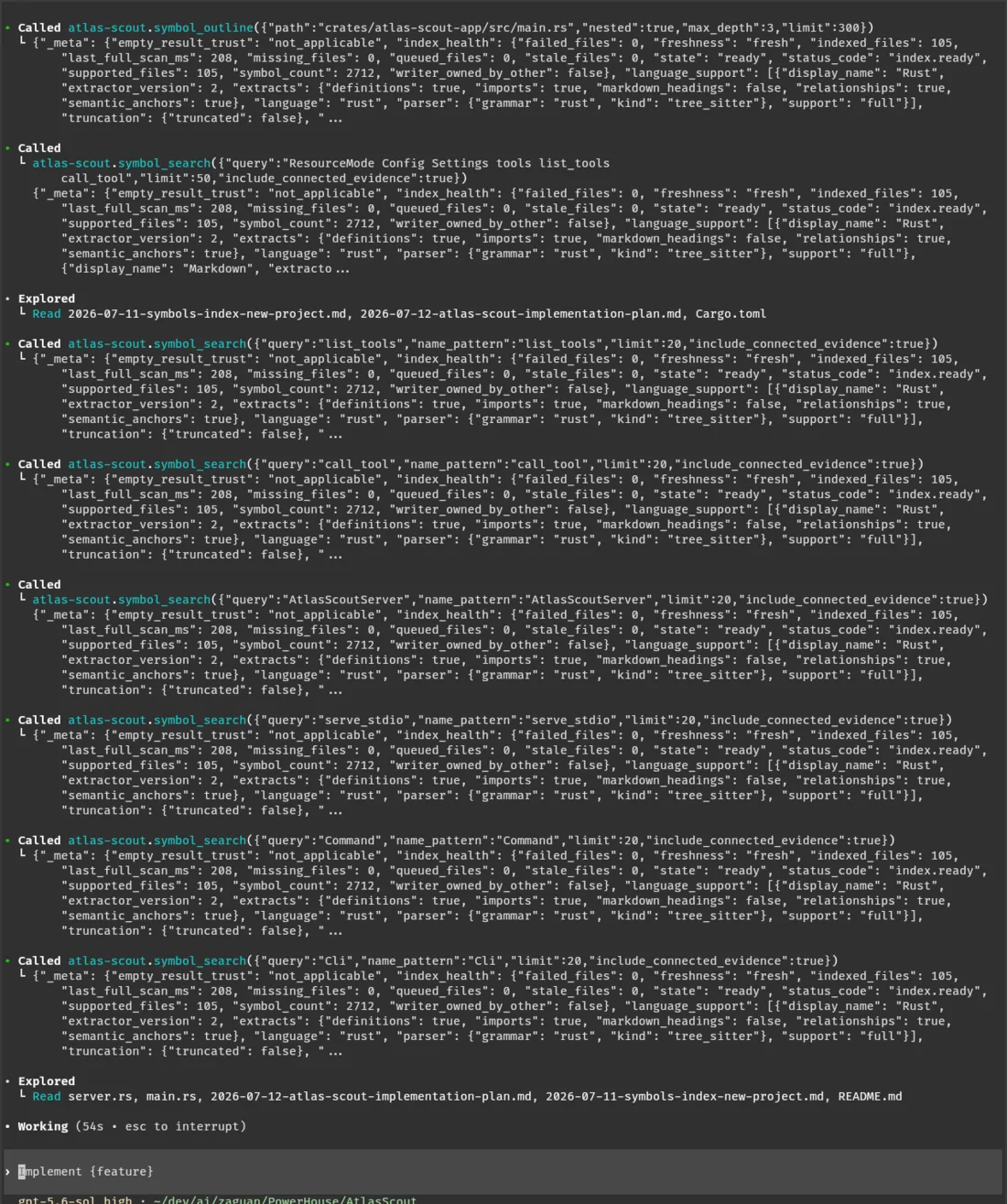
A real Codex session on a real Rust codebase: one symbol_outline, a burst of targeted symbol_search calls, and straight to work. Every answer arrives with its own receipts - index fresh, 105 files, 2,712 symbols, nothing truncated - so the agent knows it can trust what it just learned. No grep in sight.
Read https://atlasscout.dev/atlas-scout.md and follow it to set up Atlas Scout.Prefer a page you can send to a teammate? atlasscout.dev/install has the agent line, the manual script, and the verification steps in one place.
If your agent writes most of your code, Atlas Scout is leverage you never have to think about: install it once, and every session your agent stops guessing at file names, stops breaking functions it didn’t know were used elsewhere, and stops burning your budget re-reading the same files. You don’t need to know what an index is. Your agent does - and it shows up smarter.